Autism Learning Partners Closes New York Medicaid Panels as Reimbursement Falls Below National Benchmarks
PR Newswire
BUFFALO, N.Y., April 17, 2026
Two consecutive rate cuts force intake closure, eliminating capacity to serve approximately 425 additional children in 2026
BUFFALO, N.Y., April 17, 2026 /PRNewswire/ -- Autism Learning Partners (ALP), one of the nation's largest and longest standing providers of Applied Behavior Analysis (ABA) therapy, announced today that it has closed all New York Medicaid panels for new Medicaid and Child Health Plus (CHP) patients effective April 17, 2026 for both Applied Behavior Analysis (ABA).
This decision follows two consecutive rate reductions to ABA services—a 12.5% decrease implemented on October 1, 2025, and an additional 12.5% reduction effective April 1, 2026—which have materially reduced reimbursement and rendered continued Medicaid services financially unsustainable.
"These reductions come at the exact moment when New York families are finally gaining access to autism services through Medicaid," said Dr. Gina Chang, PhD, BCBA-D, President and CEO. "Unfortunately, the current reimbursement structure no longer supports the ability to ensure access to care for incoming Medicaid members in a sustainable way that protects the quality of the care."
Significant Impact on Access to Care
ALP currently serves 523 children across New York, including 480 Medicaid and CHP members, with 118 children already waiting for services.
In recent years, ALP has focused on reducing wait times and improving access to care for children in high-need Medicaid communities across New York. However, recent rate reductions have resulted in:
- Eliminated capacity to serve approximately 425 additional children in 2026 who would have otherwise accessed care through ALP's planned wait list reduction
- Families already waiting for services will continue to face extended delays, losing critical months—or even years—of access to medically necessary care
- Access constraints will directly impact vulnerable Medicaid-dependent families
Regional Impact Highlights
- Buffalo / Erie / Niagara: ~230 clients (largest population served)
- Capital Region (Albany area): ~140 clients
- Rochester / Monroe: ~75 clients
- Bronx / Westchester: ~65 clients
These regions represent some of the highest-need Medicaid populations in the state and are expected to experience increased strain on already limited provider capacity.
Expansion Halted Across Key Regions
ALP operates six locations across New York, including centers in Buffalo, Albany, and Rochester, and provides services in Westchester County and the Bronx.
Plans for additional centers have been halted, including a new center in Albany and a new center in Yonkers. "These were planned expansions based on demonstrated community need," said Dr. Rachael Schneider, PhD, BCBA-LBA, Executive Director for NY, and NY resident. "Halting them means fewer providers, fewer available treatment hours, and longer delays for families seeking care. I had the honor of being a part of the Buffalo community when access opened to Medicaid families and seeing the way it transformed their lives—it is devastating what these reimbursement reductions are doing to access and quality care."
Financial Sustainability and Regional Rate Disparities
Recent rate reductions place New York among the lowest reimbursed states for ABA services, despite having one of the highest costs of living in the country.
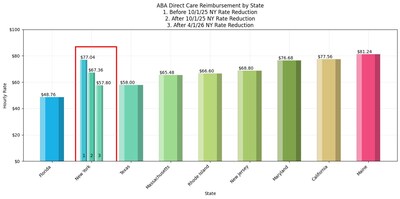
Following the April 1, 2026 reduction, New York's reimbursement rates are now lower than those in Texas, despite substantially higher costs associated with delivering care. Autism Learning Partners has also recently made the decision to exit the entire Texas market earlier this year due to rates that were too low to sustain operations.
"These rates do not align with the economic realities of providing care in New York," said Dr. Mirella Petersen, DHA, MISM, Vice President of Payor Relations and Government Affairs. "When reimbursement falls below sustainable levels—even compared to lower-cost states—it directly impacts access for families."
Broader System Implications
Reducing access to early intervention does not reduce costs—it shifts them to more intensive and expensive systems later.
Limiting access to autism services is expected to result in:
- Increased emergency, psychiatric, and crisis care utilization
- Increased reliance on special education placements costing $100,000–$150,000 annually per student
- Greater utilization of residential and out-of-home placements costing $250,000–$400,000+ per year
- Long-term public costs, with lifetime care estimates reaching $3.5 million per individual without appropriate intervention
Call for Policy Reconsideration
ALP is urging state leaders to reconsider the current reimbursement structure and ensure that funding aligns with the cost of delivering high-quality, evidence-based care. "New York has made meaningful progress in expanding access to autism services," Dr. Gina Chang, PhD, BCBA-D, President and CEO. "We remain committed to working with the State to ensure that progress is not reversed."
About Autism Learning Partners
Autism Learning Partners is a leading provider of evidence-based autism services, offering center-based, home-based, and community-based Applied Behavior Analysis (ABA) therapy. ALP serves thousands of children and families nationwide and has supported individuals with autism in New York for over a decade.
 View original content to download multimedia:https://www.prnewswire.com/news-releases/autism-learning-partners-closes-new-york-medicaid-panels-as-reimbursement-falls-below-national-benchmarks-302746300.html
SOURCE Autism Learning Partners

